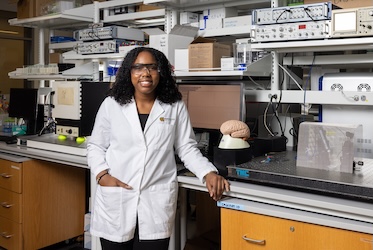
A team of UTHealth Houston researchers slowed and even reversed diabetic nerve damage in mice, bringing researchers one step closer to developing a treatment for humans.
Press ReleasesMedical Research#UTHealth Houston#research#Top News#Press Release#medical research#clinical research
Medical ResearchLife SciencesEnvironment & Climate#Kennesaw State University#research#News Releases#medical research#clinical research#genomics#biology#climate
Research NewsUniversity of Minnesota Medical School
A University of Minnesota Medical School research team has been awarded up to $6 million from the Advanced Research Projects Agency for Health (ARPA-H), an agency within the U.S. Department of Health and Human Services, to develop more effective treatments for people with severe mental health issues, including thoughts of suicide.
Medical ResearchResearch#University of Minnesota Medical School#UMN Medical School#research#medical research#clinical research
Thirteen percent of U.S. children aged 3–17 have a diagnosed mental or behavioral health condition, and American youth suicide rates far exceed those of peer countries. But the popular story — a sudden, smartphone-driven collapse — doesn't fit five decades of data. This series examines where the crisis comes from, which interventions demonstrably help, and what we still need to learn.
ResearchMedical Research#Yale University#research#Yale#Yale News#medical research#clinical research
Research NewsUniversity of Minnesota Medical School
A University of Minnesota-led multi-institutional research team has discovered a highly potent small molecule that blocks Ebola virus entry by stabilizing the virus's entry protein and provides strong protection when given orally in a preclinical model.
Medical ResearchLife SciencesResearch#University of Minnesota Medical School#UMN Medical School#research#medical research#clinical research#genomics#biology
Medical ResearchTechnology & Innovation#Kennesaw State University#research#News Releases#medical research#clinical research#advanced materials#innovation
Qingyu Chen, PhD , and his team set out to study how artificial intelligence (AI) language models are adapted for medicine and found that what these models memorize can be both useful and risky. A model may retain valuable medical knowledge, but in a controlled study using real hospital records, the same fine-tuning—the added training that adapts a model to a specific task—that improved diagnostic
ResearchMedical Research#Yale University#research#Yale#Yale News#medical research#clinical research